
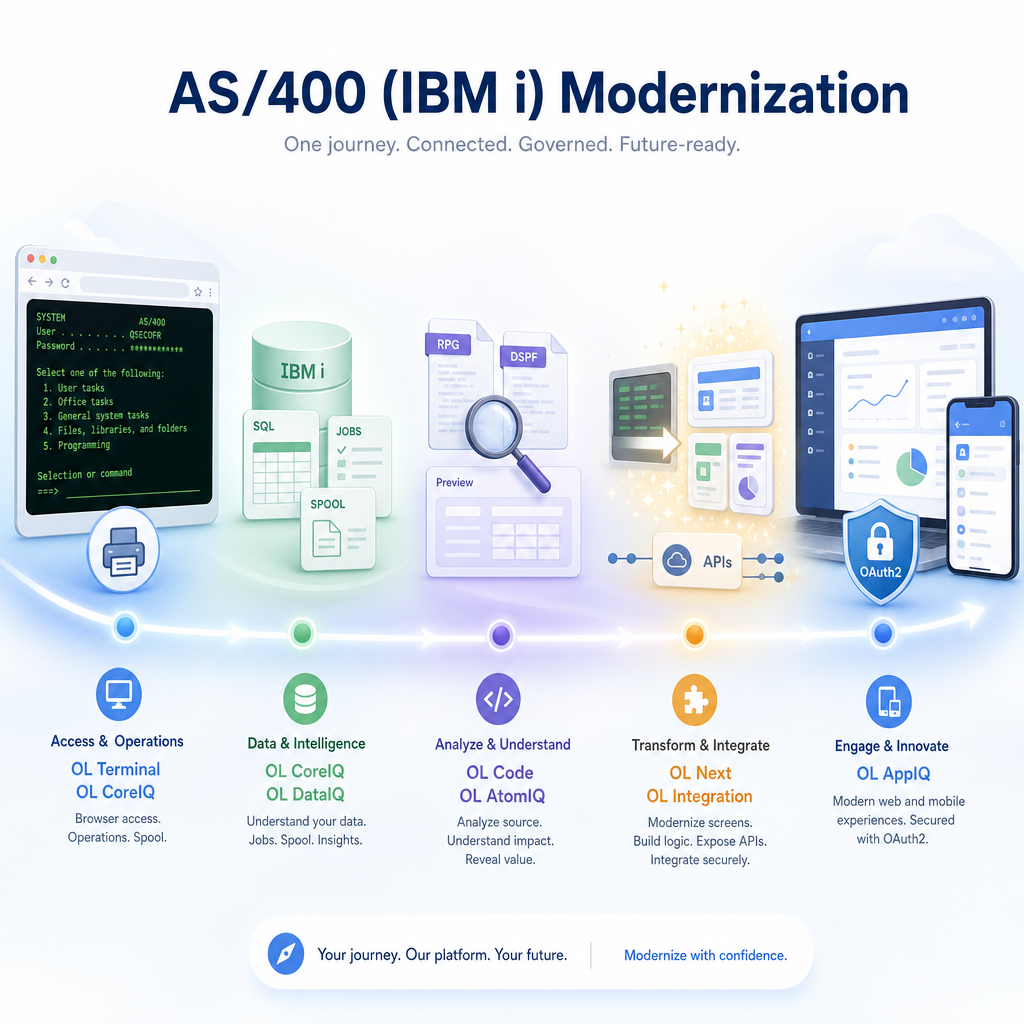
AS/400 (IBM i) Modernization
Give IBM i shops a single modernization path—from day-one browser access and green-screen operations through RPG/DSPF analysis, RPC conversion, governed APIs, and OAuth2-secured modern front ends—without stitching together point tools across OL CoreIQ, OL Terminal, OL Code, OL AtomIQ, OL Next, OL AppIQ, OL DataIQ, and OL Integration, or re-inventorying the same RPG and DSPF assets each time OL Hub adds a new capability.
Challenges
- The people who can read your RPG are retiring faster than you can replace them. IT leaders now rank IBM i skills as their #1 concern for the platform (Fortra 2026 IBM i Marketplace Survey, 320 respondents) — ahead of cybersecurity, for the first time ever.
- Interest in AI on IBM i jumped from 30% to 42% of shops in a single year (Fortra 2026 IBM i Marketplace Survey) — but you can't point an agent at a green screen. Without a governed API layer underneath, that appetite has nowhere to go.
- Most days still start with a 5250 emulator and end with logic only two people in the building can actually read. Without a governed browser alternative, that's the default, not the exception.
Benefits
- One platform to evaluate and govern, not a shelf of point tools from separate vendors stitched together after the fact.
- The discovery work only has to happen once — every new initiative builds on the same foundation instead of starting over.
- Integration, replatform, and reimagine—three real paths, not a mandatory sequence. Start wherever the business need actually is: expose governed APIs today, convert only the pieces that need a new runtime, or jump straight to a full reimagine if that's the right call from day one. Whichever path you choose, and in whatever order, it draws on the same underlying discovery—so no work gets wasted no matter where you start.
Give IBM i teams one place to access, explore, expose, and modernize AS/400 systems—from browser-based 5250 terminal access and program/data operations, through RPG and DSPF source analysis, to API exposure, code conversion, and OAuth2-secured modern front ends.
Products
-
OL CoreIQ — AS/400 (IBM i) workbench: SQL, jobs, spools, libraries, program calls, and FTP over JT400/DB400
-
OL Terminal — browser-based 5250 terminal access, printer/spool integration, managed users, session recording, and Hub screen-flow playback against a live session
-
OL Code — AS400 source explorer/editor, Hub asset testing, and reverse API client generation (AS400_COBOL / AS400_RPG)
-
OL AtomIQ — IBM i as a first-class platform: JT400 import, DB400 metadata, DSPF map preview, and RPG analysis
-
OL Next — convert RPGLE screen and RPC programs into runnable legacy code on the JVM; teams keep editing RPGLE in OL Next off the host, with data via DB400/JDBC, an H2 sandbox, or a modern DB after migration
-
OL AppIQ — OAuth2 authentication against AS/400 security for modern apps
-
OL DataIQ — DB400 connections, DB2/AS400 procedure editing, and Hub ETL/DB Poller from DB400
-
OL Integration — IBM i legacy connectors and 3270/5250 terminal Screens Flow methods as governed Hub APIs
What it covers
-
Browser access to AS/400 systems: 5250 terminals, spool/printer management, and governed program/data operations
-
RPG and DSPF source inventory, analysis, and map preview
-
RPGLE screen/RPC conversion to runnable, testable legacy code on the JVM — edit the same RPGLE in OL Next while it runs off the host
-
REST/Hub API exposure of IBM i programs and DB400 data, including terminal Screens Flow automation
-
OAuth2/JWT modern-app authentication backed by AS/400 security
-
Roadmap: OL Screener AS400/5250 remote map transport (planned) will extend map ScreenFlow APIs to DSPF maps