
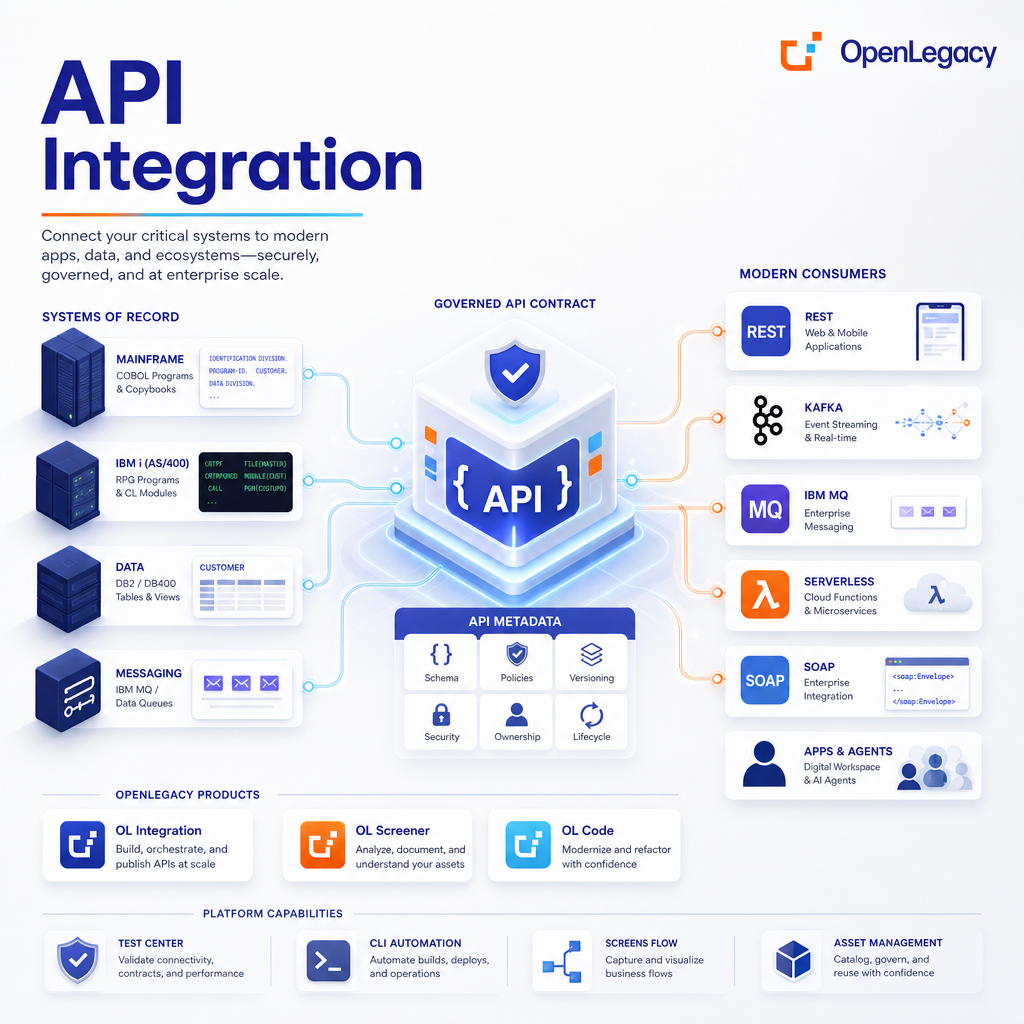
API Integration
Ship governed APIs and events from mainframe and IBM i assets faster than custom connector builds or general-purpose integration platforms, with repeatable design, test, and runtime operations across OL Integration (terminal Screens Flows and asset management), OL Screener (map ScreenFlows), OL DataIQ (DB system APIs), and OL Code — building on OL Hub's shared discovery and specification work instead of starting each integration from zero.
Challenges
- Most applications still aren't connected, so IT teams spend a large share of time designing, building, and testing custom integrations between systems and data.
- Agentic AI turns that gap into a blocker because agents need API-driven access to mainframe and IBM i logic that is still trapped in programs, screens, and messaging.
- Hand-rolled connectivity relocates cost rather than removing it: each operation still needs asset interpretation, field-by-field mapping, and contract testing.
Benefits
- Ship governed REST, Kafka, IBM MQ, Serverless, and SOAP endpoints from one Hub contract without rebuilding each integration.
- Expose RPC and 3270/5250 terminal Screens Flows as testable APIs without rewriting the systems of record.
- Start from a versioned catalog of already-discovered operations instead of rediscovering and mapping each legacy asset.
Turn mainframe and IBM i business logic—programs, screens, transactions, and messaging—into governed APIs and events for modern consumers, without rewriting the systems of record underneath them.
Products
-
OL Integration — connectors, contract-first APIs, RPC and terminal Screens Flow methods (3270/5250), Test Center, CLI automation, and asset management for the operations methods invoke
-
OL Screener — map ScreenFlow APIs (CICS/BMS via MQ, IMS/MFS via IMS Connect)
-
OL AtomIQ — map analysis; can create Integration terminal Screens Flows from COBOL + BMS maps
-
OL DataIQ — DB system APIs generated directly from DB2/DB400 tables, queries, and stored procedures
-
OL Code — create and test Hub API assets from COBOL in the IDE
What it covers
-
Legacy connectors for mainframe and IBM i assets, backed by a versioned, testable metadata catalog of every operation a method invokes
-
Contract-first and friendly API design
-
Multi-technology endpoints from one contract—REST, Kafka and IBM MQ events, Serverless, SOAP, and more
-
RPC and terminal Screens Flow methods (3270/5250)
-
Map ScreenFlows for remote BMS/MFS conversations (OL Screener)
-
Automation (CLI) and Test Center validation
How it compares
Against broad integration platforms like MuleSoft, OpenLegacy's documented edge is focus: exposing mainframe and IBM i business logic as modern APIs without rewriting core systems, rather than general-purpose enterprise connectivity. Against IBM's own z/OS Connect, the differentiator is range: OL Integration handles both straightforward system APIs and orchestrated, multi-step APIs—RPC flow methods and terminal Screens Flow—across mainframe and IBM i, not z/OS alone. Where a project only needs direct system APIs generated from CICS, DB2, or VSAM assets without that orchestration layer, OL CoreIQ and OL DataIQ cover that more directly, under OpenLegacy's separate Legacy Data APIs capability.